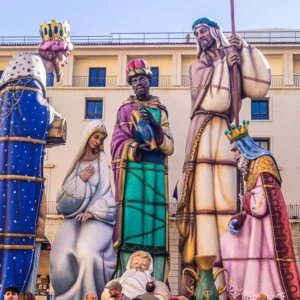

Cruces de Mayo in Elche 2026: dates, programme and religious procession
Cruces de Mayo in Elche is a religious and cultural celebration linked to the Catholic tradition of veneration of the Holy Cross and takes place at the beginning of May. Unlike the more decorative and street-oriented versions that are held in other cities of the Valencian Community, the format in Elche has a strongly liturgical character and is organised with the participation of local brotherhoods (cofradías) and the support of municipal structures.
Historically, the festival is connected to the Christian calendar, in which 3 May is dedicated to the Holy Cross. In Elche, this date has evolved into a contemporary form of celebration based on processions and prayer services, rather than large-scale decorative urban installations. The focus is placed on religious content, symbolism, and the participation of parish communities.
The main difference between the Cruces de Mayo in Elche and similar celebrations in cities such as Alicante or Córdoba lies in the absence of large decorative cross exhibitions in public spaces. Instead, the central element is the solemn procession that runs through the historic centre of the city, connecting key religious points, including the Parish of San Juan Bautista and the Basilica of Santa María.
In this way, the Cruces de Mayo in Elche should not be understood as a tourist festival in the conventional sense, but rather as a living form of religious tradition that preserves its liturgical foundation and reflects the continuity of the city’s connection with its Catholic heritage and the activity of its local brotherhoods.
History and significance of the Cruces de Mayo in Elche
Historically, the development of this celebration in the city follows the broader Spanish tradition, which dates back to early Christianity and the cult of Saint Helena, who, according to ecclesiastical tradition, discovered the True Cross in Jerusalem. However, in Elche this element has gradually transformed into a local expression of religious practice, in which the procession and the communal participation of the faithful play a central role.
The cofradías play a fundamental role in the organisation and preservation of the tradition. These religious brotherhoods coordinate the preparation of events, the participation of the faithful, and the development of the processions. Historically, they constitute an essential pillar of Elche’s religious life, ensuring the continuity of traditions and their transmission between generations.
In the cultural life of the city, the Cruces de Mayo occupy the space of a smaller-scale but highly symbolic religious celebration, complementing larger festivities such as Holy Week and the Misteri d’Elx, declared Intangible Cultural Heritage of Humanity by UNESCO. In this context, the festival acts as an extension of the city’s living spiritual tradition and reflects its close relationship with Catholic identity and communal religious practice.
Dates and programme of the Cruces de Mayo in Elche 2026
The celebration of Cruz de Mayo in Elche in 2026 takes place with the support of the Elche City Council and the participation of local brotherhoods (cofradías). Unlike other cities, the format in Elche has a primarily religious character, focused on liturgical acts and processions.
Dates of Cruz de Mayo in Elche 2026
- April 30, 2026 – official opening
- May 8, 2026 – religious events
- May 9, 2026 – main day of the celebration
Official Program: Cruz de Mayo Elche 2026
April 30, 2026
- Opening of the festival
- Pregón de la Juventud Cofrade
- Location: Trinquet (Universidad CEU Cardenal Herrera)
May 8, 2026
- 21:00 – Prayer vigil (Vigilia de oración)
- Location: Parroquia de San Juan Bautista
- Followed by a participants’ gathering
May 9, 2026
Main day program:
- Meeting of brotherhoods (cofradías)
- Children’s activities
17:00 – Procession of the Holy Cross
- Participation of more than 140 costaleros
- Departure from Parroquia de San Juan Bautista
- Route through the historic city centre
- Arrival at Basílica de Santa María
- Return to the starting point
Route of the Cruz de Mayo procession in Elche 2026
The central element of the celebration of the Cruz de Mayo in Elche is the solemn religious procession, which runs through the historic centre of the city and connects the main spiritual points linked to Elche’s Catholic tradition. The itinerary of the procession is organised around the most significant religious spaces and maintains a stable structure, characteristic of urban liturgical celebrations. In 2026, it traditionally includes the following stages: Parish of San Juan Bautista → historic centre of the city → Basilica of Santa María → return to the starting point.
The starting point of the procession is the Parish of San Juan Bautista, one of the key parishes in the city, from where the solemn procession begins with the participation of brotherhoods (cofradías), participants in traditional attire, and carriers of the religious float (costaleros). The route then continues through the historic centre of Elche, including the main streets, where most of the public viewing area is concentrated. In this section, the procession takes on its most solemn character, reflecting the close relationship between the urban environment and religious tradition.
The most important final point is the Basilica of Santa María, the main church of the city, with special significance in the religious and cultural history of Elche. At this location, the procession makes a stop symbolising the spiritual conclusion of the route and its connection with local Catholic tradition. Afterwards, the procession returns to its starting point, closing a circular itinerary that emphasises unity, community participation, and the continuity of religious tradition within the urban environment of Elche.
Main locations of the Cruz de Mayo in Elche
- Parish of San Juan Bautista
- Basilica of Santa María
- Historic centre of Elche
Characteristics of the Cruz de Mayo in Elche
The celebration of the Cruz de Mayo in Elche has a distinctly religious and ceremonial character and is marked by a more restrained format compared to other cities in the province of Alicante. Here, the emphasis is not placed on mass street entertainment, but on the spiritual content of the event and the participation of religious brotherhoods.
One of its main features is the close connection with the parish life of the city. Most activities are organised by the cofradías, which are responsible for preparing the crosses, decorating altars, and carrying out the procession. These organisations play a fundamental role in preserving Elche’s Catholic traditions and transmitting them across generations.
Unlike more tourism-oriented celebrations, the Cruz de Mayo in Elche maintains a local character. The decorated crosses are mainly placed in church spaces and nearby squares, rather than as large urban installations. Traditional elements are used, such as fresh flowers, textiles, candles, and symbolic religious ornaments.
The participation of parishioners and local residents also stands out. Preparation for the festival usually begins in advance and involves collective community work, reinforcing the social value of the event. In this way, the Cruz de Mayo is not only a religious act, but also a way of strengthening community ties within the neighbourhoods of the city.
In the cultural context of Elche, known for traditions such as the Misteri d’Elx, the Cruz de Mayo complements the annual calendar of religious celebrations and reflects the city’s strong connection with its Catholic heritage and local identity.
Tips for visitors to the Cruz de Mayo in Elche 2026
Visiting the Cruz de Mayo in Elche requires a basic understanding of the nature of the event: it is a religious procession and a local parish celebration, not a mass festival. Below are practical recommendations based on the traditional organisation of the event in the city.
When to attend
The optimal arrival time depends on the main stages of the programme. The most important moments take place in the evening, when the procession occurs and the streets of the historic centre become the main route for participants.
It is recommended to arrive in advance, at least 30 to 60 minutes before the start of the procession, in order to secure a good viewing spot along the route and become familiar with the religious atmosphere beforehand. Daytime hours are suitable for visiting the decorated crosses in parishes and surrounding areas.
Best places to watch the procession
The best viewing points are located along the main routes in the city centre. Traditionally, spectators gather near key religious sites such as the Parish of San Juan Bautista and the streets leading to the Basilica of Santa María.
The wider sections of the historic centre are especially recommended, where the procession slows down. In these areas, it is possible to observe in greater detail the religious elements, the participation of brotherhoods, and the traditional symbols of the procession.
How to move around the centre
The historic centre of Elche is compact, and during the Cruz de Mayo most routes are entirely pedestrian. During the procession days, vehicle access may be restricted in several central streets.
The most convenient way to move around is on foot, allowing free access between religious points and activity areas. Public transport can be used to reach the city centre, after which the rest of the route can be completed on foot.
It is important to consider possible temporary traffic restrictions and plan movements in advance, especially during procession hours.
FAQ: Cruz de Mayo in Elche 2026 – 10 additional questions and expanded answers
1. Is the Cruz de Mayo in Elche a tourist festival?
No, in Elche it is primarily a religious event linked to the Catholic tradition of veneration of the Cross. The tourism component is secondary, and the main focus is on parishes and brotherhoods.
2. Do you need to buy tickets?
No, access to the processions and religious activities is free of charge. The event takes place in public spaces and parish churches.
3. Is there a fixed date?
Yes, the celebration is traditionally associated with the beginning of May, close to 3 May (Feast of the Holy Cross). Exact dates are confirmed each year by parishes and local authorities.
4. Where do the main religious activities take place?
The main events are concentrated in the city’s parishes, including the Parish of San Juan Bautista, the areas around the Basilica of Santa María, and the historic city centre.
5. Can you take photographs during the procession?
Photography is generally allowed, although it is recommended to maintain a respectful distance and not interfere with the procession. Restrictions may apply inside churches.
6. How large is the event?
Compared to larger cities, the Cruz de Mayo in Elche has a smaller, more local format, with participation mainly from residents and brotherhoods.
7. Who organises the event?
The organisation is carried out by the brotherhoods, parish communities, and ecclesiastical structures, with logistical support from the city council.
8. Is there tourist infrastructure around the event?
Yes, although it is not the central focus of the celebration. The city offers hotels, restaurants, and transport, but the main activity is concentrated in the religious sphere.
9. Is it suitable for families with children?
Yes, the atmosphere is calm and safe. However, it is recommended to respect the religious nature of the event and maintain silence during ceremonies.
10. How does it differ from other cities?
The main difference is its more spiritual and restrained character. Unlike other places where the festival is more decorative or festive, Elche emphasises liturgical content and processional tradition.
Conclusion: is it worth visiting the Cruz de Mayo in Elche?
The Cruz de Mayo in Elche is, above all, a religious and cultural celebration deeply rooted in the city’s Catholic tradition. Its format is not aimed at mass tourism but at preserving spiritual heritage and encouraging participation from parish communities.
It is especially recommended for those interested in living religious traditions in Spain, processions, and the local culture of the Valencian Community. Unlike more spectacular events, the focus here is on atmosphere, symbolism, and community participation.
It is important to understand that this is not a show or a large urban festival, but an organised procession, religious rituals, and traditional cross decorations within a devotional context.
Its cultural value lies in historical continuity. The Cruz de Mayo in Elche reflects the city’s close relationship with the Catholic calendar and complements other important heritage elements such as the Misteri d’Elx. This makes it an essential part of the city’s historical and cultural identity.
Ultimately, the Cruz de Mayo in Elche 2026 is of interest to those seeking an authentic cultural experience, wishing to understand Spain’s religious traditions, and willing to observe in a calm and respectful environment.
Tags: cruz de mayo elche 2026 dates official programme procession elche cruz de mayo 2026 schedule san juan bautista basilica santa maría elche procession 2026 cruz de mayo elche itinerary historic centre elche religious procession may elche 2026 cofradías elche cruz de mayo programme elche 2026 when is cruz de mayo elche 2026 holy cross festival elche spain procession route elche may 2026 elche religious events may 2026 cruz de mayo elche history meaning elche catholic traditions procession elche 2026 basilica santa maría elche events san juan bautista elche procession schedule elche may festivals 2026 elche religious celebrations spain may 2026 cruz de mayo elche guide visitors elche processions calendar elche cultural events may 2026 elche religious tourism cruz de mayo elche route map elche old town procession elche may 3 celebration elche spain cofradías tradition elche religious brotherhoods elche festival catholic elche spain events cruz de mayo decorations elche elche processional route details elche tourism may events elche spain religious heritage misteri d’elx and cruz de mayo elche elche may calendar events spain elche holy cross celebration elche spain church procession elche visitor guide 2026 cruz de mayo elche timetable elche evening procession route elche city centre closures may 2026 elche festival schedule official elche religious culture valencia region elche may things to do elche spain religious festivals elche processions guide elche cultural heritage events spain elche catholic festival schedule elche tourism religious events elche spain may religious calendar elche 2026 procession times elche spain cultural traditions elche historic centre events may elche spain pilgrimage style events
Share this article
*This article is an informational overview. Official schedule, tickets, and updates are published on the organizers’ websites.
*If you notice any inaccuracies or errors in this article, please let us know by email: mist@costa-blanca.space.
-

Santa Bárbara Castle in Alicante – How to Get There, What to See & Why It’s Worth Visiting
-

Tabarca Island, Costa Blanca, Spain: How to Get There, What to See and Why Visit
-

Drone Aerial Video Production on the Costa Blanca: Video Services for Business, Real Estate, Events, and Tourist Locations
-

El Palmeral Park in Alicante: a Palm Grove with a Lake, How to Get There, What to See, and Why It’s Worth Visiting
-

Alicante 2026: City Safety for Tourists and Residents – Crime Rate, High-Risk Areas, and the Best and Worst Neighborhoods to Live In
-

Moraira, Costa Blanca: Best Beaches, Hidden Coves & Top Things to Do (2026 Travel Guide)