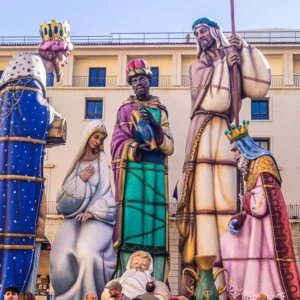

Festa de la Cruz in Benidorm 2026: programme, dates and traditions
Festa de la Cruz in Benidorm is a traditional religious and cultural celebration linked to the Catholic veneration of the Holy Cross, which takes place in early May within the broader Spanish tradition of the Day of the Holy Cross (3 May).
In Benidorm, the festival retains a local character and is developed primarily as a parish and community event rather than a large tourist festival.
From a historical perspective, the tradition of veneration of the Cross dates back to early Christianity and is associated with the cult of Saint Helena, mother of Emperor Constantine the Great, to whom ecclesiastical tradition attributes the discovery of the True Cross in Jerusalem. In Spain, this feast spread during the Middle Ages and was later consolidated in the liturgical calendar of the Catholic Church.
What is the Festa de la Cruz in Benidorm
In Benidorm, the Festa de la Cruz is organised around local parishes and religious communities. The main elements of the celebration include solemn masses, small processions or pilgrimages (romerías), as well as the decoration of symbolic crosses with flowers in ecclesiastical and community spaces.
Unlike larger and more decorative interpretations of the festival in cities such as Alicante or Elche, where large urban installations are created, in Benidorm the emphasis is placed on the spiritual dimension, prayer practice and the participation of local residents rather than visual displays.
Thus, the Festa de la Cruz in Benidorm in 2026 should be understood as part of a living Catholic tradition in the Valencian Community, which maintains its religious character and its close connection with the parish life of the city.
History of the Festa de la Cruz in Benidorm
The origins of the Festa de la Cruz in Benidorm are linked to the broader Christian tradition of veneration of the Holy Cross, which was formed in the early centuries of Christianity and was officially incorporated into the Catholic calendar as the feast of the Day of the Holy Cross (3 May). In Spain, this tradition spread during the Middle Ages and developed local forms in different regions.
In Benidorm, the festival does not have a documented ancient origin like in other historic centres of Spain, but its modern form was consolidated within the religious life of the municipality in the 20th century, when parish communities began to regularly organise May devotions and symbolic acts of veneration of the Cross.
The development of the festival in the city is closely linked to the importance of the parish structure of San Jaime and Santa Ana, which historically represents the main religious centre of Benidorm. Around parish life, the traditional elements of the celebration gradually took shape: masses, processions and small community gatherings of the faithful.
An important role in the preservation and organisation of the Festa de la Cruz is played by local religious brotherhoods and neighbourhood associations (cofradías and neighbourhood associations). These organisations are responsible for preparing the events, coordinating participants and maintaining the traditional format of the festival, which is primarily oriented towards the local community.
In the liturgical context, the Festa de la Cruz remains part of the Catholic calendar, closely related to the Easter cycle and May religious celebrations. Unlike larger regional festivals, in Benidorm it maintains a more intimate character, reflecting the city’s identity as a modern tourist centre with a stable local religious tradition.
Programme of the Festa de la Cruz in Benidorm 2026
The Festa de la Cruz in Benidorm is a traditional religious and cultural celebration held with the support of the Benidorm City Council and in collaboration with the parish of San Jaime and Santa Ana, as well as local festival and neighbourhood associations.
In 2026, the event maintains its classic structure based on liturgical acts, popular traditions and community participation.
According to the official municipal programme, the festival takes place between 30 April and 3 May 2026, with 3 May as the Day of the Holy Cross.
Main official events
- “Decoration of the Cross” (Vestida de la Cruz) – solemn floral decoration of the cross, marking the beginning of the festive cycle.
- General ringing of bells – traditional signal announcing the start of the celebration in the historic centre.
- Pilgrimage to the Cross – popular romería towards the symbolic Cross of the Term, with the participation of residents, festival associations and local authorities.
- Blessing of the municipal area – religious prayer ceremony for the protection and well-being of the city.
- Reading of the traditional poem – symbolic performance, often carried out by young participants.
Religious and cultural events
- Floral offering at the parish of San Jaime and Santa Ana – one of the central moments of the celebration.
- Solemn mass with musical accompaniment by choirs and local groups.
- Concerts and musical performances by city musical societies.
- Mass for the deceased as the final religious act of the programme.
Main locations
The main activities are concentrated in Plaza de la Cruz, the parish of San Jaime and Santa Ana, and the historic centre of Benidorm.
The romería and symbolic acts follow traditional urban routes, maintaining the local and community-based character of the event.
In 2026, the Benidorm City Council maintains a traditional approach to the festival, combining religious heritage, cultural identity and citizen participation in one of the city’s most representative spring celebrations.
Dates and times of the Festa de la Cruz in Benidorm 2026
In 2026, the Festa de la Cruz in Benidorm takes place within the traditional dates established by municipal and parish practice: from the end of April to 3 May, with 3 May as the Day of the Holy Cross.
Below is an indicative timetable based on the annual programme of the city council and parish organisation.
Indicative programme of activities
- 30 April 2026 (18:00–20:00) – solemn decoration of the Cross (Vestida de la Cruz), start of the festive cycle
- 1–2 May 2026 (19:00–20:30) – evening masses and parish prayer services
- 3 May 2026 – main day of the festival
- 09:00 – solemn ringing of bells
- 11:00 – solemn mass at the parish of San Jaime and Santa Ana
- 18:00 – traditional romería to the symbolic Cross
- 20:00 – floral offering and main religious acts
- 21:30 – musical accompaniment and closing of the programme
It is important to note that in Benidorm the Festa de la Cruz has a flexible parish-based format: exact times may vary slightly depending on parish organisation and municipal coordination.
Procession and pilgrimage of the Holy Cross in Benidorm 2026
Within the Festa de la Cruz in Benidorm 2026, the central religious act is the traditional romería (pilgrimage) and symbolic procession organised by the parish of San Jaime and Santa Ana with the support of the Benidorm City Council and local organisations. These celebrations reflect the Catholic tradition of veneration of the Holy Cross and maintain a community-based character.
Route and main points
The procession route in Benidorm is organised around the historic centre of the city and its traditional religious spaces. In 2026, the main route follows this structure:
- Parish of San Jaime and Santa Ana – starting point of the religious acts
- Historic centre of Benidorm – main section of community participation
- Plaza de la Cruz (Cross area) – symbolic final point of the romería
The route has a spiritual rather than tourist meaning, highlighting the connection between urban space and religious tradition.
Participants in the procession
The procession includes various groups reflecting the social and religious structure of the city:
- parish communities of Benidorm
- religious brotherhoods (cofradías)
- municipal representatives
- local musical groups
- city residents, including families
Participation is voluntary and reinforces the community-based nature of the festival.
Symbolism and atmosphere of the Festa de la Cruz in Benidorm
The symbolic centre of the festival is the Cross, decorated with flowers and placed in public or religious spaces. It is interpreted as a symbol of protection and spiritual unity of the community.
The atmosphere of the procession in Benidorm is solemn and calm. Unlike other cities with larger-scale celebrations, here the format is intimate and focused on prayer and religious tradition.
In 2026, the Benidorm City Council maintains this format as part of the city’s cultural heritage.
Main locations of the Festa de la Cruz in Benidorm 2026
In 2026, the main events of the Festa de la Cruz in Benidorm are distributed across several key locations in the city, with strong symbolic and organisational value:
- Plaza de la Cruz – central symbolic space of the festival, where floral decoration and main ceremonies take place.
- Parish of San Jaime and Santa Ana – main religious centre where solemn masses and official liturgical acts are held.
- Historic centre of the city – area through which processions and community activities pass, integrating religious tradition with urban life.
This distribution reflects the historical integration of religious life, urban space and the local community in Benidorm.
Tips for visiting the Festa de la Cruz in Benidorm 2026
Visiting the Festa de la Cruz in Benidorm in 2026 requires understanding its religious and local character. It is primarily a parish celebration rather than a mass tourist festival, so visitor behaviour and planning should respect the ceremonial format of the events.
Best time to visit
The most important events take place between end of April and 3 May 2026, with the key day being 3 May (Day of the Holy Cross).
The optimal visiting time depends on the type of activities:
- Morning (10:00–13:00) – solemn masses and religious services at the parish of San Jaime and Santa Ana
- Evening (18:00–21:30) – processions, romería and main public events of the festival
It is recommended to arrive early, as main locations fill up 30–60 minutes before key events.
Where to watch the processions
The best viewing points are located in the historic centre and along traditional procession routes:
- Plaza de la Cruz area – symbolic focal point of the festival
- Surroundings of San Jaime and Santa Ana parish – start and end of religious acts
- Narrow streets of the historic centre – allow a closer and more detailed view of the procession
It is recommended to choose wider areas where the procession moves more slowly, allowing better observation of religious elements and brotherhood participation.
Getting around the city
During the festival, Benidorm’s centre becomes mainly pedestrian, especially during processions and romerías:
- vehicle access to the historic centre may be restricted
- the main way to move is on foot
- public transport is recommended only for reaching the centre
Temporary street closures may occur, so planning ahead helps avoid delays and move comfortably between key locations.
Differences between the Festa de la Cruz in Benidorm and other cities
In 2026, the Festa de la Cruz in Benidorm maintains regional characteristics that distinguish it from similar celebrations in other cities of the Alicante province and the Valencian Community. Although they share a common religious foundation, local formats vary significantly.
Comparison with Elche, Alicante and Valencia
In cities such as Alicante or Valencia, the Day of the Holy Cross often takes on a more visual and large-scale character, with emphasis on urban decoration, large ornamental crosses and extensive cultural programmes.
In Elche, the tradition also maintains its religious base but includes more structured processions with strong historical-liturgical symbolism and close ties to local brotherhoods.
In Benidorm, however, the format is much more compact and focused on parish practice, without large urban installations or tourist-oriented shows.
More local and calm format
The main feature of Benidorm is the local character of the festival. Activities are concentrated in the historic centre and parish area, creating an intimate and calm atmosphere.
Unlike larger cities, there is no mass tourist concentration, and participation is mainly focused on residents and parish communities.
Lower tourist orientation
The Festa de la Cruz in Benidorm is not conceived as a tourist festival. Although it attracts visitors, the official programme of the city council and parishes is primarily focused on religious content and local community participation.
This is reflected in the limited presence of commercial activities, the absence of large entertainment zones and the priority given to liturgical acts over recreational programming.
In 2026, Benidorm thus maintains a traditional model where religious practice and local identity take precedence over tourism.
FAQ: Festa de la Cruz in Benidorm 2026 – additional questions and detailed answers
1. Do I need to reserve a place to watch the procession?
No, no reservation is required. Processions take place in open public spaces and spectators position themselves along the route on a first-come, first-served basis. However, in key central areas it is advisable to arrive early due to limited space.
2. Is there a dress code for religious events?
There is no official dress code, but for attending mass or religious acts, modest clothing is recommended (covered shoulders, no beachwear).
3. Are shops and restaurants open during the festival?
Yes, most establishments in Benidorm remain open. However, in procession areas there may be temporary restrictions or schedule changes due to street closures.
4. Can tourists participate in the procession?
Direct participation in liturgical processions is usually reserved for parish members and religious brotherhoods. Tourists may observe but do not take part officially.
5. Is the festival noisy?
The Festa de la Cruz in Benidorm is a quiet religious celebration. Main sound elements include bell ringing, band music and choral accompaniment. Fireworks or noisy night events are not typical.
6. Are events held in case of rain?
Yes, masses are held regardless of weather. However, outdoor processions may be shortened or modified depending on conditions and organisers’ decisions.
7. Are there restrictions on photos and videos?
Photography is generally allowed in public spaces, but restrictions may apply inside churches. Flash should be avoided and religious proceedings must not be disturbed.
8. How long does the main procession last?
The procession usually lasts between 1 and 2 hours depending on the route and number of participants. The romería may take longer if the programme is extended.
9. Is parking available near event locations?
Parking in the city centre is limited during the festival. It is recommended to use peripheral parking areas or public transport.
10. Is it part of the official city fiestas?
The Festa de la Cruz is not one of Benidorm’s major fiestas, but it is included in the municipal calendar as a traditional spring religious celebration supported by the city council and parishes.
Conclusion: is the Festa de la Cruz in Benidorm worth visiting?
The Festa de la Cruz in Benidorm 2026 holds an established place in the city’s religious and cultural calendar and represents an example of a living parish tradition within a modern tourist environment. The festival is based on the Catholic veneration of the Holy Cross and involves the participation of the city council, the parish community of San Jaime and Santa Ana and local associations.
Cultural value of the festival
From a cultural perspective, the Festa de la Cruz is part of the broader Spanish and Valencian religious heritage linked to spring festival cycles. Despite its modest scale, it plays an important role in transmitting traditions, symbols and local religious practices.
Key elements include processions, floral decoration of the cross and active parish participation, which allows the festival to be understood as a form of local intangible cultural heritage.
Importance for Benidorm’s identity
The Festa de la Cruz contributes to Benidorm’s local identity, complementing the city’s image as a tourist destination. Religious festivals help maintain a link with historical heritage and strengthen community cohesion.
For residents, it is not only a tourist event but an expression of community belonging and religious continuity between generations.
Is it worth visiting?
The Festa de la Cruz in Benidorm is recommended for those interested in authentic religious traditions and local Valencian culture.
It is not a mass festival or entertainment show, but a structured religious event focused on symbolism, processions and community participation.
In 2026, the festival maintains its traditional format and offers a deeper understanding of Benidorm’s cultural identity beyond its tourist image.
Tags: fiesta de la cruz benidorm 2026 program, benidorm cross festival 2026 dates, santa cruz festival benidorm schedule, fiesta de la cruz benidorm history, what is fiesta de la cruz in benidorm, benidorm religious festivals may 2026, cross day benidorm events, benidorm easter and may celebrations, san jaime y santa ana church events benidorm, benidorm may religious festivals guide, fiesta de la cruz procession benidorm route, benidorm romeria santa cruz 2026, cross decoration tradition benidorm, benidorm cultural events may 3, is fiesta de la cruz tourist event benidorm, benidorm religious procession schedule 2026, santa cruz day spain traditions, alicante region cross festival traditions, valencia region may festivals religious events, benidorm local fiestas calendar 2026, where to see fiesta de la cruz benidorm, benidorm plaza de la cruz events, benidorm church celebrations may, history of santa cruz festival spain, benidorm religious tourism events, benidorm traditional festivals explanation, benidorm may 2026 events calendar, when is fiesta de la cruz celebrated spain, catholic festivals in benidorm, benidorm parish festivals san jaime santa ana, benidorm flower cross decoration tradition, spain may religious holidays traditions, benidorm cultural heritage events, best time to visit benidorm fiesta de la cruz, benidorm processions may festival route, santa cruz festival origins spain, benidorm quiet religious festivals, benidorm local community festivals 2026, what happens during fiesta de la cruz benidorm, benidorm may 3 celebration meaning, spanish cross day traditions valencia region, benidorm historical center festivals, religious events in benidorm spring 2026, benidorm festival guide for tourists may, cross festival spain small towns traditions, benidorm cultural and religious events overview, benidorm semana santa and may differences, benidorm traditional catholic celebrations, benidorm fiesta schedule official calendar, visit benidorm during fiesta de la cruz 2026
Share this article
*This article is an informational overview. Official schedule, tickets, and updates are published on the organizers’ websites.
*If you notice any inaccuracies or errors in this article, please let us know by email: mist@costa-blanca.space.
-

Santa Bárbara Castle in Alicante – How to Get There, What to See & Why It’s Worth Visiting
-

Tabarca Island, Costa Blanca, Spain: How to Get There, What to See and Why Visit
-

Drone Aerial Video Production on the Costa Blanca: Video Services for Business, Real Estate, Events, and Tourist Locations
-

El Palmeral Park in Alicante: a Palm Grove with a Lake, How to Get There, What to See, and Why It’s Worth Visiting
-

Alicante 2026: City Safety for Tourists and Residents – Crime Rate, High-Risk Areas, and the Best and Worst Neighborhoods to Live In
-

Moraira, Costa Blanca: Best Beaches, Hidden Coves & Top Things to Do (2026 Travel Guide)