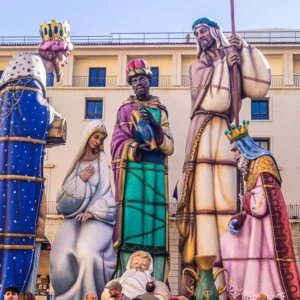

Semana Santa (Easter Week) in Benidorm 2026: Dates, Processions and Tips for Tourists
Semana Santa is one of the most impressive traditional events in Spain. In 2026, Holy Week in Benidorm combines religious tradition, processions and mild spring weather in a relaxed, family‑friendly atmosphere.
What is Semana Santa (Holy Week) and its brief history?
Semana Santa (Holy Week) is the main religious period in Spain, dedicated to the last days of Jesus Christ’s life: his suffering, death and resurrection. It is not just a religious event, but also a mixture of deep tradition, culture and street spectacle.
What Semana Santa means
Semana Santa is the week before Easter and includes key events from Christian history:
- Palm Sunday (Entrance of Jesus into Jerusalem)
The start of Holy Week. People welcome Jesus as a king, laying palm branches on his path. This day symbolizes recognition and hope. - Maundy Thursday (The Last Supper)
The final meal of Jesus with his disciples, when he institutes the Eucharist. A symbol of unity, loyalty and coming trials. - Good Friday (The Crucifixion)
The day of Jesus’ suffering and death on the cross. The most dramatic and emotional moment, symbolizing sacrifice and redemption. - Easter Sunday (The Resurrection)
The victory of life over death. The central event of Christianity, a symbol of hope, renewal and new life.
These events are “played out” in the streets through processions and symbolic actions.
Why there are processions
The main feature of Semana Santa is street processions. They originated as a way to “tell the story” to people when most were unable to read.
- Platforms (pasos) show scenes from the Bible.
- Participants in traditional robes symbolize penitence.
- Music and moments of silence create a strong emotional atmosphere.
It is like an open‑air street theatre with deep religious meaning.
Brief history
The tradition of Semana Santa in Spain dates back to the Middle Ages:
- First processions appeared in the 12th century.
- Strong growth in the 16th century, during the Catholic Reform.
- Brotherhoods (cofradías) became the main organizers.
Many customs have been preserved for hundreds of years and continue from generation to generation.
Why it is so important in Spain
Today Semana Santa is not just religion, but also a key part of Spanish culture:
- Combines faith, art and tradition.
- Involves local residents and families.
- One of the most significant events of the year.
In Spain, this is when life literally moves into the streets.
How Semana Santa looks in Benidorm
In Benidorm, Semana Santa is celebrated in a more relaxed way than in larger cities, but it keeps all the key elements:
- Processions with pasos and music.
- Participation of local brotherhoods.
- A traditional, calm atmosphere without extreme overcrowding.
This makes it ideal for tourists who want to understand the meaning of the festival without heavy crowds.
When does Semana Santa take place in Benidorm in 2026?
In 2026, Easter falls on April 5.
- March 29 – Palm Sunday
- April 2 – Maundy Thursday
- April 3 – Good Friday
- April 5 – Easter Sunday
The main events run from March 29 to April 5.
Semana Santa in Benidorm 2026: Processions, Schedule and Routes
Main processions: dates, times and where to watch
- Palm Sunday (March 29, 2026) – start of the Holy Week
Time: usually from 10:30–12:00 (daytime procession)
Route: starting from the Church of San Jaime y Santa Ana → the old town → central streets
Where to watch: the squares near the church and wider streets are best for families and a relaxed viewing experience. - Maundy Thursday (April 2, 2026) – evening and night processions
Time: approximately from 19:00–23:00
Route: the old town (Casco Antiguo) → narrow streets → back to the church
Where to watch: corners and uphill sections are good for photos and balance of atmosphere and manageable crowd. - Good Friday (April 3, 2026) – the main and most impressive processions
Time: during the day (around 12:00) and the main evening procession from 20:00–00:00
Route: a full route through the old town, the city centre and main squares
Important: this is the most crowded day – arrive at least 60 minutes in advance. - Easter Sunday (April 5, 2026) – festive Easter procession
Time: morning, around 10:00–12:00
Route: central streets and the old town
Where to watch: open spaces and squares, with a lighter, cheerful atmosphere and fewer people.
Tip: If you have limited time, choose Maundy Thursday or Good Friday – these are the most visually impressive days.
Route map through the city
The main routes run through the historic old town and central streets. The processions form a loop, so you can choose the best spot along the path.
Best places to watch the processions
- Old Town (Casco Antiguo)
- Square in front of the church (Iglesia de San Jaime y Santa Ana)
- Levante Beach promenade
Which day to see: a guide for tourists
If you do not plan to attend all Holy Week events, this guide will help you choose the best days.
Best day for families
Palm Sunday (March 29, 2026)
- A lighter, more festive atmosphere.
- Less intense than Good Friday.
- Children often participate with palm branches.
- Processions are held during the day.
Ideal for families with children and a calm introduction to the traditions.
Best day for photography
Good Friday (April 3, 2026)
- The most dramatic and visually rich processions.
- Night processions with candles.
- Strong contrast of light and shadow.
- Traditional robes and large, detailed pasos.
The best choice for atmospheric and professional‑style photography.
Atmosphere vs crowds
Maundy Thursday (April 2, 2026)
- Strong, emotional atmosphere, but fewer people than on Good Friday.
- Evening and night processions.
- A good balance between spectacle and comfort.
A good option if you want to feel the atmosphere without extreme crowding.
Bonus: Easter Sunday (April 5, 2026)
- A more joyful and light atmosphere.
- Less drama, more celebration.
Perfect for a relaxed, positive finish to your trip.
Best spots for photography in Benidorm
During Semana Santa in Benidorm, several locations are ideal for capturing the most atmospheric photos of the processions.
Old Town (Casco Antiguo)
- Narrow streets create a dramatic perspective.
- Close proximity to participants of the procession.
- Authentic old‑town atmosphere.
Square in front of the Church of San Jaime y Santa Ana
- Key starting and finishing point for many processions.
- Beautiful architectural backdrop.
- Excellent for evening photos.
Balcón del Mediterráneo (Mediterranean Balcony)
- Panoramic sea views.
- Processions seen from the elevation.
- Especially beautiful at sunset.
Levante Beach promenade
- Wide open space for flexible shot angles.
- Good natural light during the day.
- Parts of the route sometimes pass along the promenade.
Tips for photographers
- Arrive in advance to secure a good spot.
- Best lighting: evenings and night (candles, street lights).
- Use a fast lens to shoot in low light.
- Avoid using flash, as it breaks the atmosphere and may disturb participants.
Where to sit, where to stand and how to avoid crowds
Tourists often ask where it is most comfortable and safe to watch the processions in Benidorm. Here are practical tips.
Best places to sit
- Squares and open spaces near the Church of San Jaime.
- Cafés and restaurants along the route with terraces.
- Levante Beach promenade, with more space and lower density of people.
Ideal if you are with children or older adults.
Best places to stand
- Narrow streets in the old town – maximum immersion.
- Street corners where processions slow down.
- The beginning or end of the route, which are usually less crowded.
Where crowds are smaller
- Sideways streets near the main route.
- Less busy days, such as Maundy Thursday or early morning events.
- Daytime processions.
The biggest crowds occur on the evening of Good Friday.
How to avoid heavy pressure from the crowd
- Arrive 45–60 minutes before the start.
- Avoid the central squares at peak hours.
- Do not stay in very narrow sections without exit routes.
- Stay towards the edge of the street, not in the middle of the flow.
Practical tips
- Choose elevated positions or steps for better view and less crowding.
- Move along the route and “catch” the procession at quieter points.
- Combine: watch in the centre first, then move to a more relaxed area.
How to get to Benidorm and move around the city during Semana Santa
During Holy Week in Benidorm, tourist numbers increase and some roads may be closed. Here is how to travel and get around comfortably.
Bus from Alicante to Benidorm
- Travel time: around 45 minutes.
- Frequency: every 10–40 minutes during the day.
- Direct non‑stop buses.
This is the cheapest and most convenient way to reach Benidorm from Alicante.
Bus from Murcia to Benidorm
- Direct buses exist, but less often than from Alicante.
- Travel time: about 2–2.5 hours.
Best to book in advance, especially for Good Friday and weekends.
Alternative: TRAM (coastal train)
- Route: Alicante → Benidorm.
- Travel time: about 1.5 hours.
- Scenic route along the sea.
Perfect if you are not in a hurry and want beautiful coastal views.
By car: what to know
Parking
- Centre parking is limited and fills quickly.
- Better to use parking areas on the outskirts of the city.
- Some private lots offer hotel transfer.
Traffic restrictions and closures
- The city centre is partially closed for processions.
- Closures are especially strong on Good Friday.
- Some streets are closed early in the afternoon.
Where to leave the car
- Near the main bus station.
- Shopping‑centre parking areas.
- Private parking lots with shuttle service.
Best option: park outside the centre and walk or take a local bus until the end of the processions.
How to get around Benidorm
- City buses cover all main districts.
- Frequency: every 15–30 minutes.
- Cost: around 1.5–2 € per ride.
Walking is the easiest and most comfortable option in the old town and centre during Semana Santa.
Practical tips
- Arrive in the morning to avoid traffic jams.
- Do not rely on central parking in the evening.
- Plan your route in advance, especially on Good Friday.
Weather in Benidorm at the end of March – beginning of April and what to wear
The weather in Benidorm during Semana Santa is typically mild and pleasant, with a noticeable difference between day and night. It is not summer, but already real spring – ideal for walking and processions.
Temperature and conditions
- Daytime: 15–22°C.
- Night: 10–14°C.
- Sea temperature: about 14–16°C.
- Plenty of sunshine – up to 8 hours per day.
- Short, infrequent showers (about 8–10 wet days per month).
- Sea breeze can make it feel cooler.
What to wear during the day
- T‑shirt or light shirt.
- Jeans, light trousers or skirt.
- Comfortable shoes or trainers.
- Sunglasses.
What to wear in the evening (important)
- Light jacket or windbreaker.
- Sweater or hoodie.
- Closed shoes.
Evenings and night processions can feel cool, especially with humidity and sea wind.
Should I bring an umbrella?
- Yes, but a compact one.
- Rain showers are usually short and infrequent.
April is a changeable month (“in April, rain is normal”), so a light raincoat or umbrella is useful, especially for evening or night processions.
What to bring: a practical packing list
- A light jacket (essential for evenings and night processions)
- Layers of clothing (to adjust to changing temperatures during the day and night)
- Comfortable walking shoes or trainers for long hours on your feet
- Sunglasses and sunscreen for daytime at the beach and in the streets
Procession routes and best viewing spots
Where on the route are best for watching the processions, and which areas to avoid because of crowds and traffic closures.
General route layout
In Benidorm, most processions follow a similar pattern:
- Start: the Church of San Jaime y Santa Ana (old town)
- Then: narrow streets of the Casco Antiguo
- Exit to wider streets and the seafront promenade
- Return back to the church
It is a circular route, so you can choose any convenient spot along the way – you do not need to stand only at the start.
Best viewing spots (by type of experience)
For maximum atmosphere
Narrow streets in the old town and areas close to the church.
Pros: Close to the participants, strong emotions and full immersion.
Cons: Very dense crowds, hard to move or exit quickly.
For photography
Street corners and sections with slight inclines or slopes.
Pros: Processions slow down, giving more time for good photos.
Cons: You need to arrive early to secure a good spot.
For a comfortable, relaxed view
Wider streets beyond the old town and the Levante promenade.
Pros: More space, less pressure from the crowd.
Cons: Less dramatic atmosphere compared with the narrow streets.
For families
The end of the route and less central sections.
Pros: Calmer and safer, easier to manage children.
Cons: The procession may move faster and feel less spectacular.
Where to avoid
- The main square in front of the church during peak hours (especially Good Friday evening)
- The narrowest streets without exits
- The central part of the route in the evening
These areas have the highest density of people and almost no space for manoeuvring.
How traffic and road closures affect the route
- The city centre is fully or partially closed for cars during processions.
- Local buses may change their routes or stop running near the procession areas.
- Access to some streets is cut off in advance, especially in the evening.
If you plan to move around by car or bus, choose viewing points closer to the periphery of the route and leave more time for walking at the end.
Semana Santa in Benidorm for tourists: what is happening and what to know
If you are visiting Semana Santa in Benidorm for the first time, it may look unusual: people in long robes and pointed hoods, slow processions, moments of silence and music. It is not just a festival, but an important religious event in Spain – yet it can be understood and enjoyed even without a religious background.
What is actually happening?
Semana Santa is the Holy Week before Easter. During these days, processions symbolize the final days of Jesus Christ’s life:
- Large platforms (pasos) with sculptures are carried through the streets.
- Participants (nazarenos) walk in traditional robes and hoods.
- Live music, drums or long periods of silence shape the mood.
It is a mix of religion, tradition and open‑street spectacle.
Do you need to be religious?
No. Most tourists treat Semana Santa as a cultural event.
- You can simply watch and take photos.
- Active participation is not required.
- Nobody expects you to perform religious rituals.
Even if you are not Catholic, it is a unique experience worth seeing.
How to behave during processions
- Respect the silence during the most solemn moments.
- Do not walk through the procession line.
- Avoid using flash when taking photos.
- Be respectful to participants and other spectators.
The atmosphere is calm and respectful, and there are no strict dress rules for tourists, but neat and modest clothing is recommended.
What moments you should not miss
- Night processions with candles.
- The moment the procession leaves the church.
- The passage through the narrow streets of the old town.
These are the most atmospheric parts of the event.
What to do if you are visiting for the first time
- Choose 1–2 key days (for example, Maundy Thursday or Good Friday).
- Arrive early to secure a good spot.
- Do not try to see everything at once.
It is better to enjoy one or two high‑quality experiences than to rush through the whole week.
Semana Santa for foreigners: the key points
- It is safe and friendly.
- It suits visitors who are not religious.
- It is a great way to see authentic Spanish culture.
Safety, children and older relatives
Semana Santa is not only a beautiful event, but also a time of large crowds, especially on popular days. If you travel with children or older relatives, it is important to plan for comfort and safety.
How big are the crowds?
- The highest density is on the evening of Good Friday.
- The centre of the old town can become very crowded.
- It is hard to move quickly through narrow streets.
Crowds can be dense at peak times, but Benidorm is usually less crowded than big cities like Seville.
Attending with children
- Choose daytime processions (Palm Sunday or early afternoon events).
- Avoid very late evening processions.
- Stay near the edge of the street, not in the centre of the crowd.
- Agree on a meeting point in case anyone gets separated.
Best spots: wide streets or the promenade, where there is more space and easier movement.
Attending with older adults
- Avoid standing for too long (processions can last 1–3 hours).
- Choose spots near cafés or shops with seating.
- Arrive early to secure a comfortable place.
It is best to watch in less crowded sections of the route.
Are there any seats?
- There are no official bleachers or stands.
- You can sit in cafés or on terraces.
- Sometimes steps, low walls or small benches are used as improvised seats.
If sitting is important, choose a café along the route in advance.
Where is it easier to exit and “backup zones”
- Sideways streets near the route.
- Access to the seafront promenade.
- Wider streets outside the old town.
Avoid dead‑end, very narrow streets without exits.
Where to take a break or rest
- Cafés and bars along the route.
- Levante Beach promenade, with more space and venues.
- Shops and streets near the centre.
It is useful to mark these places on a map in advance.
How to avoid problems
- Arrive 45–60 minutes before the procession starts.
- Avoid pushing into the thickest part of the crowd without a clear reason.
- Watch your belongings.
- Plan your exit route in advance.
The main rule: always leave yourself space to move out calmly.
Important for tourists
- The atmosphere is safe and friendly.
- Serious incidents are rare.
- With basic common sense, it goes smoothly and comfortably.
Atmosphere and special features of Semana Santa in Benidorm
Semana Santa in Benidorm has a more relaxed vibe than in bigger cities.
- Fewer massive crowds.
- Intimate night processions.
- Authentic local traditions.
Is it worth coming to Benidorm for Easter 2026?
Advantages
- Comfortable, mild spring weather.
- Fewer tourists than in summer.
- A unique cultural experience that combines religion and street spectacle.
Disadvantages
- More modest in scale compared with Seville.
- Straight‑forward road closures and some traffic disruption in the centre.
Practical information for tourists
Weather
April temperatures in Benidorm are usually around 18–22°C by day, cooler in the evenings.
Where to stay
- Old town – for atmosphere and proximity to processions.
- Levante Beach area – for convenience and access to the promenade.
Transport
During processions, the centre of Benidorm may be closed to traffic. It is usually easiest to move around on foot or by local bus.
Useful tips
- Arrive in advance.
- Respect the silence during key moments.
- Dress modestly and neatly.
Who organizes Semana Santa in Benidorm?
Semana Santa in Benidorm is not a centralized festival, but a traditional religious event organized by local brotherhoods and church communities. Knowing this helps you understand the event better.
Main organizers
- Catholic brotherhoods (cofradías) – the main participants and organizers of processions.
- Parishes and the church – coordinate the religious services.
- Benidorm City Council – responsible for security, road closures and general order.
Each procession is usually run by its own brotherhood, with its own traditions, costumes and route.
What cofradías are
Religious associations, often with long‑standing histories. They:
- Prepare processions over many months of the year.
- Store, repair and decorate the large pasos.
- Organize the participants and the music.
They are the reason Semana Santa looks so visually rich and emotionally powerful.
Where is the “organizational centre”?
- Most events are linked to the Church of San Jaime y Santa Ana.
- Many processions start and finish there.
This church is the main landmark for tourists.
Role of the city and services
- Organizing road closures and detours.
- Controlling safety and people flow.
- Emergency services and police presence during key days.
Thanks to this, the event runs calmly and safely.
What is important for tourists to know
- Semana Santa is a tradition, not a commercial show.
- There is no single “ticket” or central organizer like at a music festival.
- All processions are free and open to the public.
You can freely move around and choose where to watch.
Why this matters
- Timetables may change slightly.
- Each day has its own style and mood.
- There is no single “main event” – there are several.
It is best to study the programme in advance and pick the processions that interest you most.
Top 10 extra FAQ: Semana Santa in Benidorm 2026
1. Can I come from other Costa Blanca cities just for one day to see the processions in Benidorm?
Yes. Benidorm is well connected by bus from Alicante, Torrevieja and other towns, so you can come for a single day. However, it is better to check the transport schedule and leave extra travel time, especially after evening processions when buses can be very full.
2. Is it allowed to eat and drink while waiting for the processions?
Yes. In Benidorm, people usually accept that spectators drink water or coffee and have light snacks, as long as they do not leave much litter. The main point is not to disturb others and to keep noise low, especially during the more solemn moments.
3. Which parts of the city should I avoid to reduce crowd pressure?
If you want fewer people around you, try to avoid the very central part of the old town at the start and end of the big processions. Choose spots a bit further along the route, on wider streets, or watch the procession from side streets and squares that are less crowded.
4. Can I get closer to a participant to take a photo or say hello?
No, it is not considered appropriate. Participants are in a special ritual state, and the procession moves in a strict order. It is better to take photos from a respectful distance, without touching, shaking hands, or trying to distract them from their prayerful mood.
5. Are there toilets available for tourists near the processions?
In the very centre there are usually no public toilets on the street, so it is better to use cafés or shopping centres on the way to the viewing spot. For big events, local authorities sometimes place portable toilets, but you should not rely only on them.
6. Do I need to register or buy tickets for the processions?
No. Attending processions in Benidorm is free and does not require registration.
7. What if I am late and the procession is already passing in front of me?
If you are late, stay where you are – the procession moves slowly and will pass in front of you anyway. Do not cross the route to “catch up” ahead; instead, move to a nearby side street or junction where it will arrive in a few minutes.
8. How to explain Semana Santa to children so they are not scared or bored?
Show them photos that look like a quiet, theatrical parade, not a loud party or concert. Explain that they should not push, shout, or run in front of the procession, but they can calmly watch and ask questions. Choose more relaxed sections and daytime processions for kids.
9. What to do if it suddenly rains during the procession?
Processions in Benidorm usually continue even in light rain; participants just add capes or umbrellas. As a spectator, it is better to bring a light raincoat or jacket with a hood and avoid deep puddles near the church, as the road can quickly become slippery.
10. What signals show that it is time to start leaving after the procession ends?
Once the main sound parts end (the march, quiet music, the final moment of silence) and the participants start going back to the church, it is a sign that you can begin to leave. It is better to move calmly and without rushing, especially in narrow streets where everyone leaves at the same time.
Conclusion
Semana Santa in Benidorm is a rare combination of tradition, atmosphere and comfortable tourist experience. Unlike bigger cities, you can see the same religious processions here without extreme crowds and stress.
Spring is one of the best times to visit: mild weather, fewer tourists and the chance to combine a cultural event with a relaxed seaside break.
Tags: semana santa benidorm 2026, easter benidorm 2026 dates, when is easter in spain 2026, semana santa benidorm processions dates, benidorm processions schedule, semana santa spain benidorm what is it, semana santa benidorm for tourists, what to see in benidorm at easter, benidorm easter weather april, benidorm weather march april, where to go in benidorm at easter, semana santa spain traditions, processions in spain what are they, where to watch processions in benidorm, best places for processions in benidorm, semana santa benidorm route, benidorm processions map, where are fewer people at semana santa benidorm, how to avoid crowds benidorm easter, semana santa benidorm with children, can children attend processions in spain, how to behave at processions in spain, what to wear at semana santa in spain, semana santa dress code, is it worth going to benidorm for easter, benidorm in april reviews, spring holiday in benidorm, events in benidorm march april, spring festivals in benidorm, semana santa valencia region benidorm, difference semana santa benidorm and seville, seville vs benidorm processions, where is better, benidorm processions photos, where to photograph semana santa, best photo spots benidorm processions, when do benidorm processions start, semana santa benidorm 2026 schedule, how long is a procession in spain, benidorm transport during semana santa, how to get from alicante to benidorm by bus, benidorm city centre parking at easter, road closures in benidorm during semana santa, where to stay in benidorm at easter, benidorm easter hotel prices, benidorm old town processions, church of san jaime benidorm processions, easter spain traditions and food, what is semana santa in simple words, where to go in the evening benidorm easter, is it safe at spanish processions
-

Color Palettes of the Costa Blanca: Coral and Turquoise in the Wardrobe
-

Spain Digital Nomad Visa 2026: Requirements, Costs & Application Guide
-

Saint Anthony’s Day on the Costa Blanca 2026 – Animal Blessings & Traditions
-

Costa Blanca Wine Bars: Where to Taste Local Wines
-

Tapas Bar Guide: The Best Places for Tasting
-

Restaurants with Sea Views: Where to Eat Well and Enjoy Beautiful Scenery